Most watering can disappointment traces back to a single mistake: buying for looks or capacity and ignoring how the water actually comes out. A can that douses seedlings, can’t reach the back of a shelf, or is too heavy to lift when full gets left in the shed. The three features that decide whether a can earns its keep are the spout, the rose, and the capacity, and the right combination depends entirely on what you are watering. Here is how to match them.
The spout sets your reach and control
Spouts fall into two broad camps. A long spout, typically 12 to 16 inches or more, is built for reach: it lets you steer water past dense foliage, into the back of a crowded shelf, or up to a hanging basket without climbing on anything. The length also shifts the can’s weight forward and lowers the pour arc, which gives you a slower, more placed stream. A narrow indoor spout does the opposite job at close range, delivering a thin, controllable line of water straight to the base of a rootball so you can avoid wetting leaves, crowns, or the surface of decorative pots.
The practical rule is that indoor plant people almost always want a narrow or long spout, or both in one can, because precision matters more than coverage among houseplants. Outdoor gardeners watering rows and beds care less about pinpoint placement and more about spreading water evenly, which is where the rose comes in.
Spout bore matters as well. A very fine indoor spout gives beautiful control but slows the pour and can clog if your water is hard or your can collects sediment, so it rewards the occasional rinse. A wider bore empties faster and fights clogs but is harder to aim in tight spaces. If a single can has to cover both jobs, a medium long spout with a removable rose is the most forgiving compromise.
The rose turns a stream into rain
The rose is the perforated disc that threads or clips onto the end of the spout and breaks a single stream into dozens of fine droplets. It exists for one main reason: to water without force. A bare spout pouring onto a seed tray will dislodge seeds and expose roots, while a rose with holes under a couple of millimeters across mimics gentle rain and leaves the surface undisturbed. That makes it close to essential for germination, seedlings, and newly potted transplants.
Roses come in finer and coarser versions, and better cans let you swap or remove them. A fine rose is for the delicate work above; a coarser rose covers more ground faster for established beds and lawns patches; and removing the rose entirely gives you the direct stream you want for base-watering mature plants or filling a reservoir. When you are choosing a can, a removable rose is the feature that lets one can serve several jobs, so it is worth prioritizing over a fixed sprinkler head.
Capacity is really a weight decision
It is tempting to buy the biggest can so you make fewer trips to the tap, but capacity translates directly into weight, and a can you dread lifting is a can you use less. Water weighs about 2.2 pounds per liter, or roughly 8.3 pounds per US gallon, before you count the can itself. A modest six-liter can therefore lands around 13 pounds full, and a two-gallon garden can pushes past 18. That is fine set down beside a raised bed, but awkward carried across a yard or lifted to a high shelf.
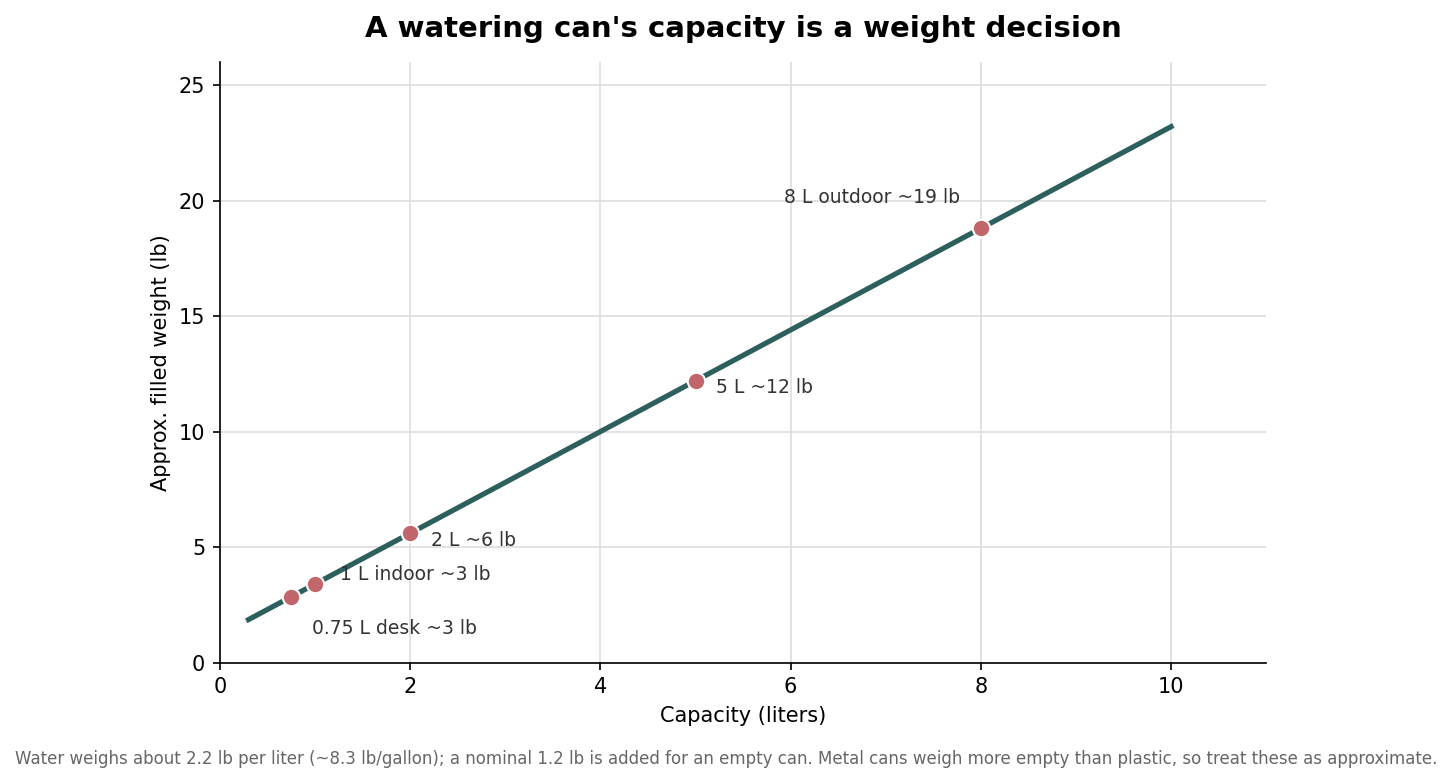
The takeaway is to size the can to the weakest lift you will regularly ask of it, not to the volume you wish you could carry. For overhead and one-handed work indoors, stay light. For ground-level beds where you can keep the can low, you can afford the extra volume and the refills you save.
Sensible sizes by setting
Translating all of this into numbers, a few ranges cover most situations. For a desk or a small indoor collection, half a liter to one liter is plenty and keeps you from overwatering. For a larger houseplant collection, one to two liters strikes the balance between fewer refills and easy handling. For seedlings and trays, one to three liters with a fine rose does the job. And for outdoor beds, five to ten liters makes sense as long as you keep the can at ground level. The chart shows those bands side by side.
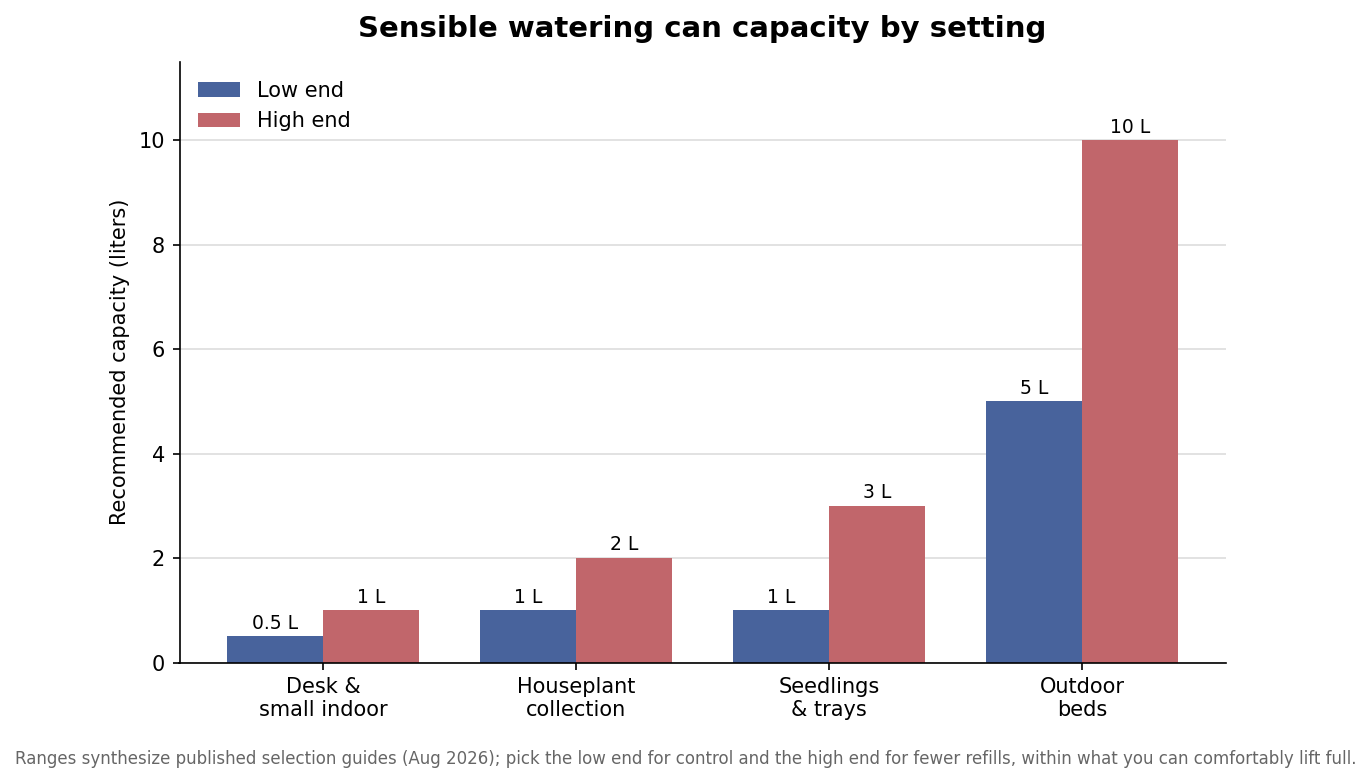
These are starting points rather than rules. Someone with arthritis may cap even their outdoor can at four liters, and a greenhouse grower may keep two cans, a small precision one and a larger workhorse, rather than compromise on one. The point is to choose deliberately instead of defaulting to whatever size looked good on the shelf.
One more consideration if the can is a gift or giveaway
Watering cans have become popular as branded gifts and event favors, and the selection logic shifts a little when the recipient is unknown. For a broad giveaway, a mid-size can in the one-to-two-liter range with a removable rose is the safest bet, because it suits both an apartment full of houseplants and a modest patio, and almost anyone can lift it comfortably. Metal cans photograph well and feel like a keepsake, while plastic keeps shipping weight and cost down for large runs. If the can will carry a logo, the shape of the body matters too, since a broad flat panel gives a printer or label a clean surface to work with. Decide who is most likely to use the can, then let the spout, rose, and capacity follow from that, exactly as you would for a can you were buying for yourself.