A galvanized watering can is one of those products that looks nearly indestructible in the shop and then, two seasons later, shows an orange bloom around the base or a rust freckle where the handle was spot-welded. Both outcomes are normal, and both are largely under your control. The metal does not fail because galvanizing is weak; it fails because of how the can is stored, how the seams were made, and how thick the zinc layer was in the first place. If you buy these cans to brand and hand out, or to resell through a garden center, it pays to understand exactly what you are working with.
What galvanizing actually does on a watering can
Galvanizing is a sacrificial zinc coating over steel. Zinc sits higher on the galvanic scale than iron, so when moisture and oxygen attack the surface, the zinc corrodes first and protects the steel underneath. That is why a scratch on a galvanized can does not immediately turn into a rust hole the way a scratch on bare painted steel would: the surrounding zinc keeps sacrificing itself across the exposed spot for a while. The coating is doing its job by slowly consuming itself.
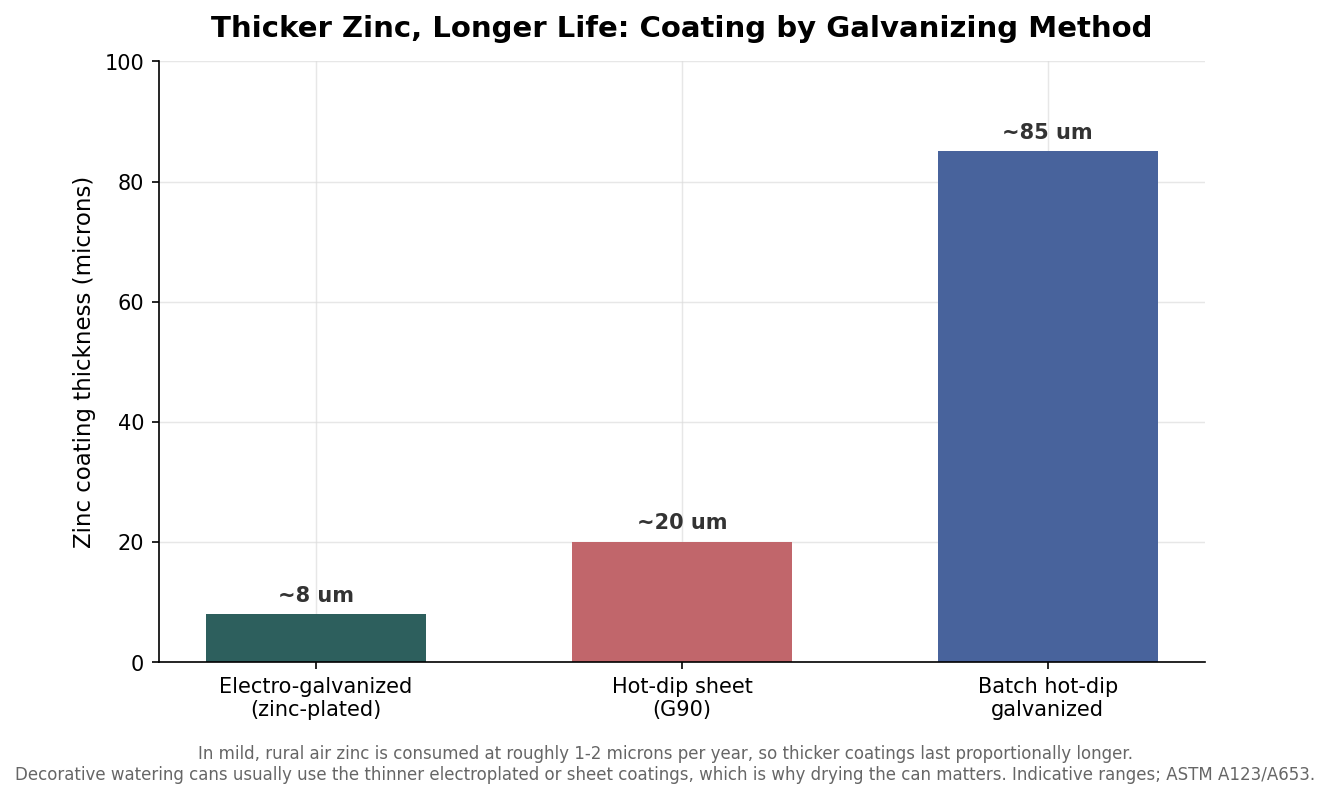
The catch is that not all galvanizing is equal, and decorative watering cans rarely carry the heavy coating you would find on a highway guardrail. Thickness is the whole story. Electro-galvanized or zinc-plated steel, common on lighter decorative cans, typically carries only about 5 to 12 microns of zinc. Hot-dip galvanized sheet used for sturdier cans runs around 20 microns per side. True batch hot-dip galvanizing, where a finished part is dipped in molten zinc, lays down roughly 85 microns. Many watering cans also add a powder-coat or painted finish over the zinc, which is a second barrier layer that keeps water off the metal entirely until it chips.
Where rust actually starts
Rust does not appear evenly across a galvanized can. It concentrates in a few predictable places, and knowing them tells you where to look and what to specify. The first is the base: water pools there whenever the can is set down full or left with an inch of water in it, and standing water is far more aggressive than the intermittent splashing the walls see. The second is seams and joints. Where two panels are folded and soldered, or where the spout and handle meet the body, the coating is thinnest and the geometry traps moisture. The third is any scratch, dent, or drilled hole that cuts through to bare steel over a large enough area that the neighboring zinc can no longer cover it.
There is also white rust, the powdery gray-white film that shows up when a freshly galvanized surface is stored wet with no air movement, such as cans nested tightly together in a damp warehouse. White rust is zinc oxide and zinc hydroxide forming before the protective, weather-stable zinc carbonate layer has a chance to develop. It is mostly cosmetic on a functional can, but it eats into the coating budget you were counting on for the years ahead, so it is worth avoiding.
How long a galvanized can really lasts
In dry, still air, zinc corrodes astonishingly slowly. In rural atmospheres the loss is on the order of 1 to 2 microns per year, which is why hot-dip galvanized structural steel can go many decades before red rust appears. Move toward the coast or an industrial area, where chlorides and sulfur compounds attack the coating, and that rate climbs to several microns a year or more. The chart below shows how dramatically environment alone shifts the timeline for structural galvanized steel.
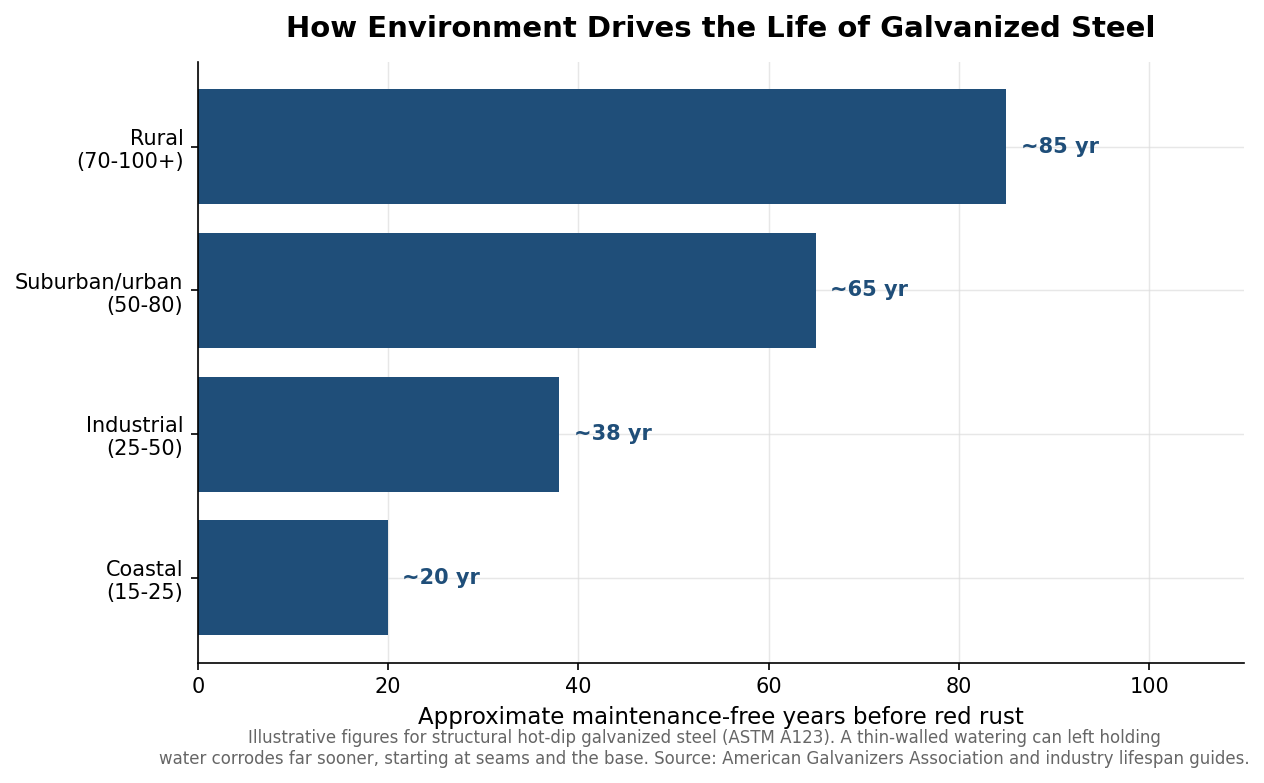
Those figures are for thick structural coatings in open-air exposure, not for a thin-walled can that spends its life holding water, so treat them as a directional guide rather than a promise. A decorative can with an 8-micron plated coating does not have 70 years in it. But the same physics applies at a smaller scale: a can that is emptied and dried lives on the flat, slow part of the curve, while a can that sits with standing water at a soldered seam is effectively living in the coastal column. The practical lifespan of a well-made galvanized can that gets dried after use is commonly several years to well over a decade; the same can left wet can show rust in a single wet season.
Care that genuinely extends the life
The single most effective habit is to empty the can after each use and let it drain and dry, ideally tipped or stored upside down so no water sits at the base. That one step removes the standing-water problem that causes most early failures. When mineral scale builds up inside from hard water, rinse with a solution of roughly one part white vinegar to three or four parts water, then rinse clean and dry thoroughly; leaving acidic vinegar in prolonged contact is counterproductive, so this is a quick descaling rinse, not a soak. Avoid steel wool and harsh abrasive pads, which grind away the very zinc layer you are relying on. If the can is powder-coated and a chip exposes bare metal, touch it up with an appropriate enamel or zinc-rich paint so water cannot get a foothold. Finally, store cans with a little air space between them rather than nested tight and damp, which keeps white rust from forming in storage.
Specifying a branded can that holds up
If you are ordering cans to print and distribute, the durability decisions are made before the artwork ever goes on. Ask what the coating actually is: a powder-coat over galvanized steel gives you both a moisture barrier and a printable, brandable surface, and it hides the visual inconsistency that raw galvanizing sometimes shows. Look at the base and seams, because a rolled or reinforced base and cleanly finished joints are where longevity is won or lost. Heavier-gauge steel, very roughly in the 0.4 to 0.6 millimeter range for decorative cans, resists denting that would otherwise crack a coating, though it adds weight and cost. And match the material honestly to the use: a can destined to be a real estate closing gift or a shelf-display retail piece can lean decorative, while one meant for daily outdoor watering at a garden center should prioritize a thicker coating and a well-sealed base.
One more number worth keeping in mind when you pick a size, since it affects both handling and how hard the base gets stressed: water is heavy. A full US gallon weighs about 8.34 pounds, so a two-gallon can holds nearly 17 pounds of water before you count the can itself. A can that is chronically overfilled and set down hard is a can whose base coating takes a beating, which loops right back to where rust starts. Choose a capacity people will actually lift comfortably, specify a coating matched to the environment, and remind whoever ends up with the can to dry it, and a galvanized watering can will outlast almost everything else in the shed.