Most watering can buyers pick a size by looking at it on a shelf, then regret it at the tap. The number that actually decides whether a can gets used every day or abandoned in the shed is not its capacity in liters; it is how much that capacity weighs once it is full, and whether the person holding it can carry and pour that weight comfortably through a whole watering session. Water is heavy in a way that is easy to underestimate, and matching capacity to the job and the person is the single most useful thing a buyer can get right.
Start from the weight, because water does not compromise
Water weighs about one kilogram per liter, or 2.2 pounds. That constant is the whole story. A one-liter indoor can holds barely two pounds of water and anyone can wield it. Step up to a five-liter can and you are lifting about eleven pounds of water before the can’s own weight, roughly a full gallon of milk and change. A large ten-to-twelve-liter garden can holds twenty-two to twenty-six pounds of water, and a fifteen-liter allotment can crosses thirty pounds full. None of that counts the can itself, which adds anywhere from half a pound for thin plastic to two or three pounds for galvanized steel or copper.
Gallon labels muddy this because a gallon is not one number. A US gallon is about 3.8 liters, while a UK gallon is about 4.5 liters, so a “two-gallon” can might hold anywhere from roughly 7.6 to 8.8 liters and weigh seventeen to nineteen pounds of water depending on which gallon the maker means. When you compare cans, compare liters, and picture the full weight rather than the empty shell.
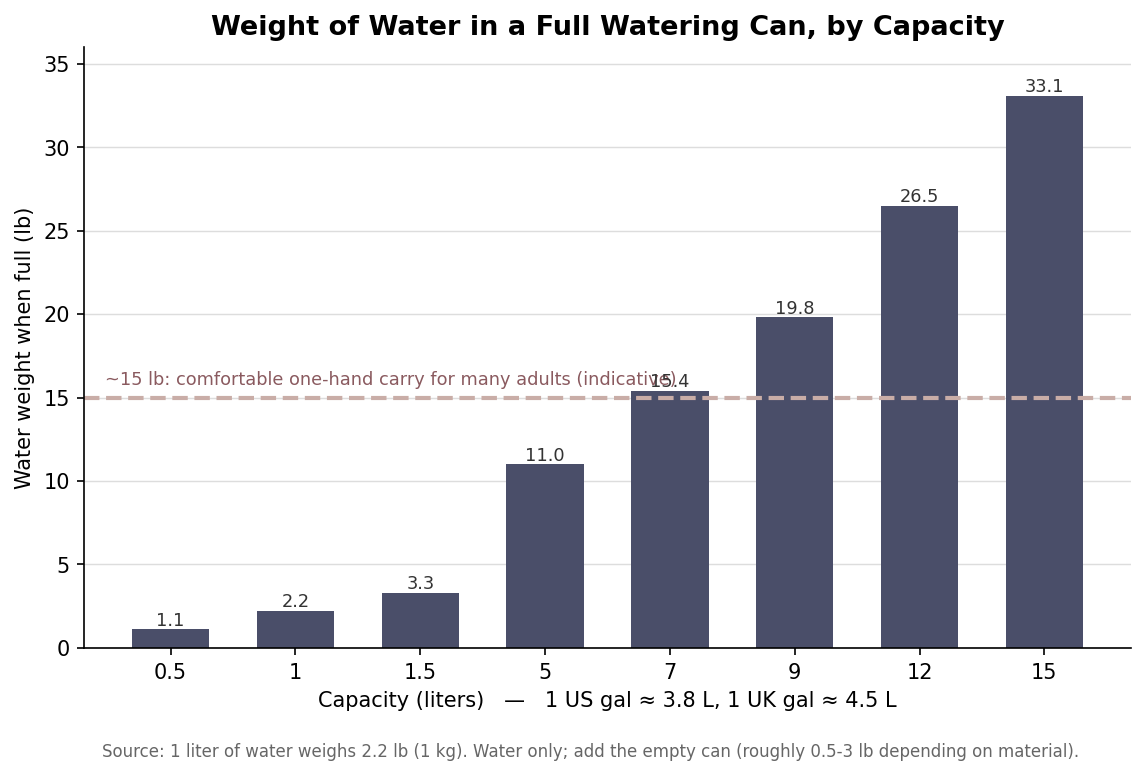
There is no official limit on a comfortable one-handed carry, but a useful rule of thumb for many adults sits around fifteen pounds for repeated lifting and pouring, which is why the chart marks that line. That threshold lands a full five-to-seven-liter can right at the edge of easy for most people and puts anything above nine liters into two-handed, fewer-trips territory. If the can is a gift or a retail product aimed at a broad audience, that ceiling matters more than the impressive-sounding capacity.
Match capacity to what is actually being watered
Once weight is in view, the right size follows from the task. For small indoor pots and seedlings, a half-liter to one-and-a-half-liter can is plenty; it is light enough for a precise pour into a crowded windowsill and small enough to store on a shelf. Larger houseplants and several pots at once justify one to two liters so you are not refilling between every plant. Patio containers and hanging baskets are the sweet spot for a five-to-seven-liter can, enough to service a balcony in a trip or two while staying under that comfort ceiling. Garden borders and raised beds reward a five-to-nine-liter can, and trees, hedges, or a plot far from the tap are where a ten-to-fifteen-liter can earns its weight because the walk back to refill costs more than the extra load.
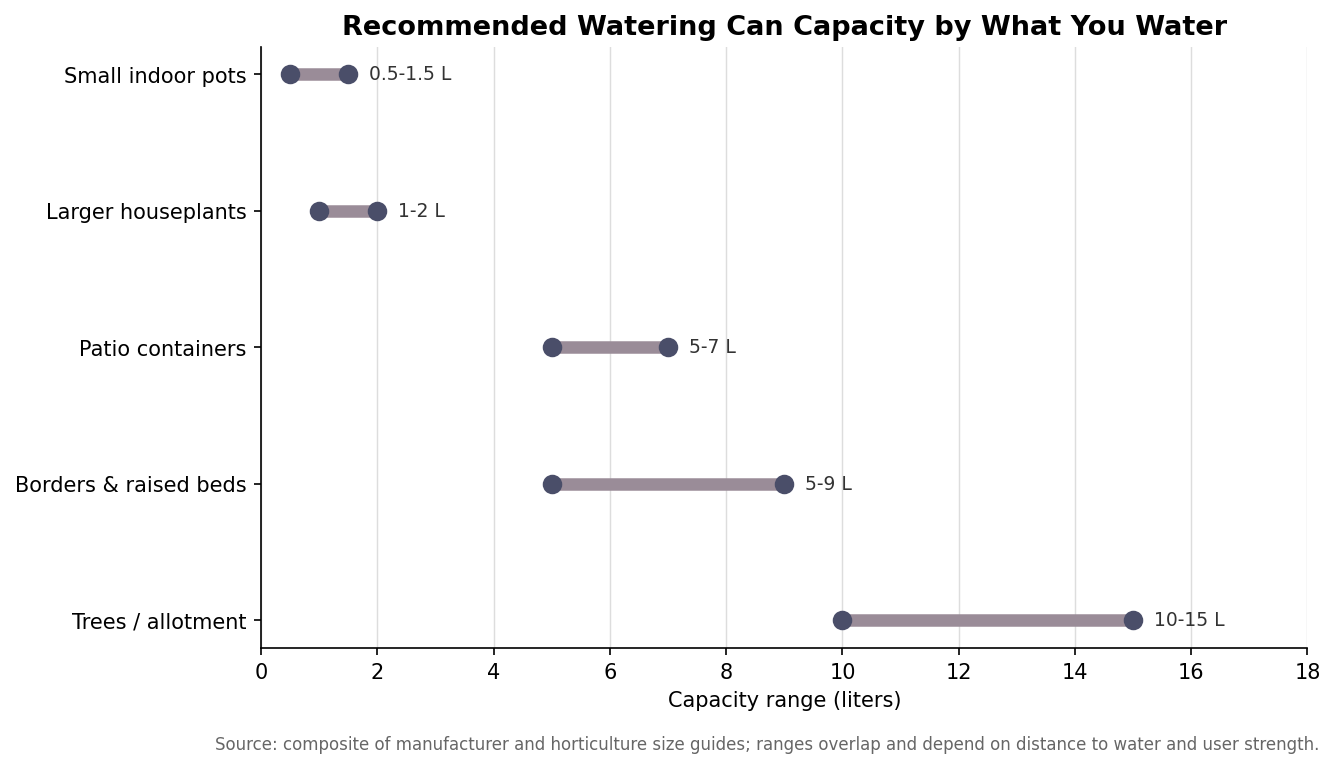
The ranges overlap on purpose, because two factors bend them. Distance to water is the first: a long carry from tap to plot tips you toward a larger can despite the weight, since fewer trips wins. The user is the second. A can chosen for an older gardener, a child’s first watering can, or a broad retail audience should sit a full size below what the plants alone would suggest, trading a refill or two for a load anyone can manage.
Balance and pour, not just the number on the box
Two cans of the same capacity can feel completely different, and the difference is where the weight sits. A long, low can carries its water closer to your hand and stays balanced as it empties; a tall, narrow can puts the mass out over the spout and forces your wrist to fight it, especially in the first heavy pour. A rear handle that arcs over the can’s center of gravity, or a dual-handle design with a grip at the back and one over the top, lets you commit the second hand exactly when the can is fullest and hardest to control. For any can above about seven liters, that second handle is the feature that keeps the last plant watered as neatly as the first.
Fill discipline is the free upgrade. A large can does not have to be filled to the brim; topping a twelve-liter can to eight liters turns a twenty-six-pound lift into a manageable eighteen and still beats hauling a small can back and forth. Buyers often size up for the capacity headroom and then simply pour less on heavy days, which is a sensible way to own one can that flexes across tasks rather than a drawer of single-purpose ones.
Turning this into a purchase
Put it together and the choice is quick. Decide what you are watering and how far it is from the tap, translate the candidate capacity into its full weight at 2.2 pounds per liter, and sanity-check that weight against who will actually carry it. If the honest answer is that the full can is too heavy, drop a size and accept the extra trip, or choose a design with a second handle and plan to fill it partway. Capacity is what the marketing leads with, but fill weight is what determines whether the can gets used, and it is entirely predictable before you buy.